Why a Clear Route Through a Room Changes Its Feel
A clear route through a room makes everyday movement feel easier. Learn how to spot bottlenecks and adjust furniture without losing comfort.
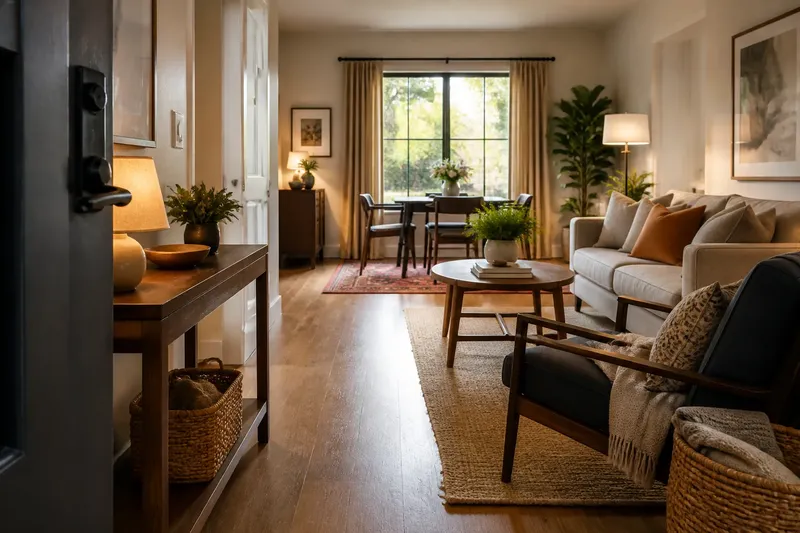
A clear route through a room can make the same furniture feel less crowded and the space easier to use. Try walking from the doorway to the sofa, window, or dining chair you reach for most; a pause, sidestep, or awkward turn is useful evidence that something is interrupting the path.
This walk-through is not about making every room look bare or arranging everything against a wall. It is a way to notice where daily movement gets tangled, then make one considered adjustment. Keep the room’s real uses in view: a route to the kitchen may matter more than a perfectly centered coffee table.
What counts as a clear route?
A route is the line people naturally follow between an entrance and a destination. It might lead from a bedroom door to a closet, from the kitchen entrance to a chair, or from the living room to a patio door. Some paths cross the room; others skim its edge. The best arrangement lets the route make sense without asking someone to squeeze past a corner or steer around a cluster of objects.
Visibility matters as much as open floor. If you can see where you are going but a chair leg blocks the turn, the path still feels interrupted. If a sofa hides the destination entirely, the room may feel harder to read even when there is space to pass. Notice how the route looks from the doorway as well as how it feels underfoot.
A route also has to accommodate what happens along it. A dining chair needs room to move in and out; a cabinet door needs its swing; a person carrying laundry may need a broader turn than someone walking empty-handed. Rather than treating circulation as an abstract line, consider the ordinary actions that take place on it.
Why does the doorway feel blocked?
What is happening: You enter and immediately angle around an armchair, console, or the end of a sofa. The room may have plenty of open floor farther in, yet the first few steps feel cramped.
What usually causes it: A large piece sits directly in the approach, or a smaller item has drifted into the natural line from the door. A narrow console can be the culprit even when it looks unobtrusive from across the room. A coat basket or shoe rack can also turn an otherwise clear entrance into a slalom.
What to try: Stand just outside the doorway and look toward the destination you use most. Move a small obstacle temporarily, then walk in with a normal stride. If the route opens up, decide whether the object can live against another wall, inside a closet, or beside the door without narrowing the approach. For a larger piece, test a modest shift or a different angle before rethinking the whole arrangement.
Imagine a living room where a round table sits just beyond the door, between the entrance and a sofa. If you move the table toward the sofa’s far side and walk in again, the expected result is a more direct entrance while the table remains within reach of the seats. The point is not the particular placement; it is checking the route after changing one thing.
Why do people keep brushing past the same furniture?
What is happening: Someone repeatedly turns sideways near a dining chair, bumps a hip against a table, or catches a sleeve on a cabinet handle. The friction may seem minor, but repeated detours make a room feel more demanding than it needs to.
What usually causes it: The walking line and the working space of furniture overlap. A chair that looks tucked in may need to slide back before anyone can sit. A coffee table can sit within easy reach of the sofa but too close to the route between the sofa and the doorway. The issue is often not a single object but the overlap between walking, sitting, opening, and reaching.
What to try: Walk through once at your normal pace, then repeat the route while mimicking the action that causes trouble: pull out the chair, carry a mug, or open the cabinet. Watch where your feet and hands need room. Shift the piece that creates the conflict, or change its orientation so its working edge faces the area it serves rather than the main path.
For a dining area, test the route with the chairs in their usual positions, not pushed neatly under the table for a photograph. If a chair interrupts the path whenever someone sits down, consider turning the table, moving it away from the doorway, or placing the most frequently used seat on the less-traveled side. Keep the route useful for the household, not just tidy when nobody is using it.
Why does the room feel crowded even with open floor?
What is happening: There is visible space in the middle, but the room still feels cluttered or hard to cross. You may find yourself walking around the edges, unsure which gap is meant to be used.
What usually causes it: Furniture creates several competing gaps instead of one legible route. A sofa, side table, and floor lamp may leave narrow openings in different directions, while a broad patch of empty floor sits unused. People tend to feel more at ease when they can read a likely path at a glance, rather than choose among awkward openings.
What to try: Pick the main destination and trace the most direct comfortable route to it. Then assess the furniture around that line as a group. Could the side table sit closer to the sofa? Could the lamp move behind a chair rather than beside the route? Could two pieces align to create a clearer passage? You do not need to eliminate every secondary path; make the most-used one easier to recognize.
Do not spend an afternoon trying to make a room symmetrical if symmetry does not help movement. Matching gaps on both sides of a sofa can look orderly but leave the actual route pinched. A clear, slightly off-center passage is often more useful than a balanced arrangement that sends everyone around the furniture.
Why does the path disappear when the room is in use?
What is happening: The room feels passable when it is tidy, then becomes difficult once a blanket, bag, basket, or laptop appears. The route may depend on everything being returned to its ideal position.
What usually causes it: Everyday objects have no convenient place near the activity they belong to, so they land on the floor or on the nearest surface. The furniture plan may account for walking but not the habits that interrupt walking. A basket that is too far from the sofa, for instance, may not collect the blanket that otherwise ends up by the doorway.
What to try: Notice what tends to drift into the route and where it comes from. Give it a nearby landing place that is outside the path: a hook beside the entry for a bag, a small tray on a side table for a remote, or a basket beside the seat for a throw. If the object repeatedly lands in the same spot, that pattern can tell you where a useful storage point belongs.
One small caution: do not add a storage piece without checking its footprint in the route. A basket may solve the blanket problem but create a new obstacle at the sofa corner. Try the proposed spot with the door open and the furniture in its everyday position before settling on it.
How can a short walk-through reveal the real problem?
Use the route you actually take, not an imagined path through an empty room. Choose a destination and walk from the entrance at an ordinary pace. Then repeat the walk while carrying something light, such as a folded towel or a book, if that reflects how you use the space. Pay attention to the moments when you slow down, turn your shoulders, reach around an object, or change direction without meaning to.
Try these checks in sequence:
- Start at the entrance. Look for an object that forces an immediate turn, and move a small item aside to see whether the approach becomes more natural.
- Follow the main destination. Trace the route to the seat, table, or doorway you use most, and notice whether the path is visible from where it begins.
- Repeat with furniture in use. Pull out a chair, open a cabinet, or stand beside the sofa as you normally would; decide which piece needs to shift if that action blocks passage.
- Check the return trip. Walk back to the entrance and see whether a corner or furniture edge catches you from the opposite direction.
- Change one thing at a time. Move a lightweight piece or temporarily relocate a small object, then walk the same route again before making another change.
For example, say you enter a bedroom and turn sideways between the foot of the bed and a laundry hamper on your way to the closet. If you move the hamper beside the closet door and repeat the walk, the expected observable result is a straighter approach and fewer steps around the bed. If the turn remains, the bed position or the closet’s use may be contributing too; the walk-through helps you separate those causes instead of moving everything at once.
Which route questions help with tricky rooms?
Should furniture sit against the walls to open a path?
Not necessarily. Pushing every piece outward can leave the center empty while making useful routes run too close to walls or door swings. Test the path to the room’s main destination and place furniture where it supports both conversation and movement.
What if two routes cross in the middle of the room?
Decide which route is used most often and keep that one easiest to follow. For the less frequent route, look for a gentle turn around a furniture group rather than a narrow passage between isolated pieces. A natural crossing is not automatically a problem if people can see and pass through it comfortably.
How do I tell whether a rug is interrupting movement?
Walk across it and notice whether an edge curls, shifts, or creates a place where you shorten your stride. A rug can define a seating area, but its edge should not sit where people need to pivot or pull out a chair. Adjust its position or choose a different size or shape that better fits the route.
What should I do if moving furniture does not help?
Look for a fixed constraint such as a door swing, radiator, built-in cabinet, or frequently used passage to another room. You may be able to redirect the route or relocate small items, but some layouts have limits. If the arrangement affects a required exit or creates a safety concern, seek suitable professional guidance rather than treating it as a styling problem.
How do you know when the route feels right?
Repeat the same walk after an adjustment and compare the experience: Can you enter without an early detour? Can you reach the destination while carrying an everyday object? Can someone else pass while a chair is in use? The route does not need to be perfectly straight. It should feel understandable and accommodate the activities that happen around it.
Make the change that resolves the clearest interruption, then live with it through ordinary use before moving heavier pieces again. A chair that looks slightly unusual from one angle may be exactly where it belongs if it leaves room to sit and keeps the doorway clear. For a clear route through a room, judge the arrangement by the way people move through it—not by whether every object lines up.
One last useful check is to look back from the destination toward the entrance. If the starting point is easy to spot and the route makes sense in both directions, the room is likely asking less of its occupants, even when it still holds the furniture and belongings that make it feel like home.