Before the Showroom: How the Reading Lamp Found Its Place
Trace how the reading lamp moved from a focused light source to a familiar part of the living room, and see what that shift says about reading at home.
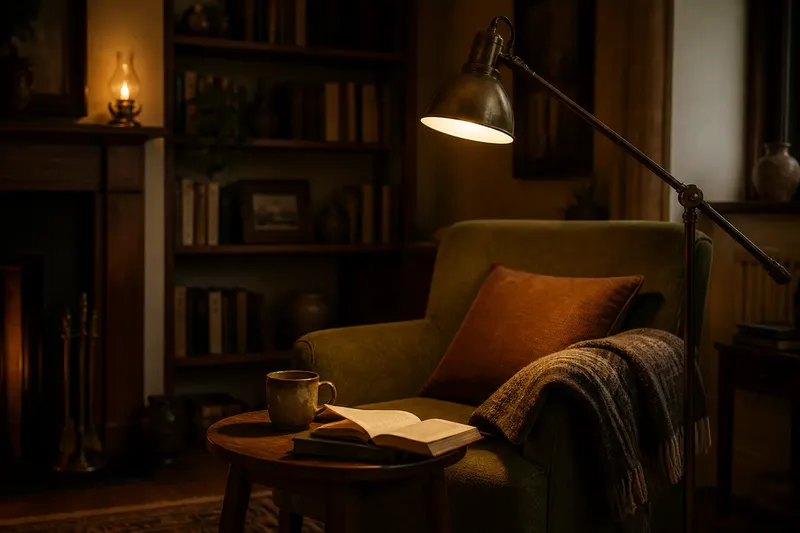
A reading lamp beside a chair looks ordinary now, but its place in the home was not always so settled. The history of the reading lamp is best understood through changes in the rooms where people read: from work surfaces arranged around a nearby flame or light source to corners that also served for conversation and rest.
Why bring a lamp close to the page?
Before electric lighting was common in homes, close reading depended on the light available in a room. A candle or oil lamp could be moved nearer to a book, while a central fixture might leave a reader needing a more local source. The details varied by household, but the practical aim was familiar: put enough light near the page without reorganizing the whole room.
A shade directed light downward; an adjustable arm let someone reposition it. These features made a lamp read as equipment, suited to a desk, worktable, or chair used for concentrated work. Its form followed a task more than a wish to make a decorative statement.
Still, a reading place was never only a lighting arrangement. A chair, table, book, and lamp created a small setting for attention. The lamp mattered because it could reach the page from the reader’s usual position, not because it looked impressive in an empty room.
How did electric lighting change the reading corner?
Electric lighting offered households another way to put light near a reader, without tending a flame. The change did not happen at the same pace in every home, and it did not erase older habits at once. As electric fixtures and lamps became familiar parts of domestic interiors, a reading light could sit beside a sofa or upholstered chair as readily as beside a desk.
That placement makes room for a broader interpretation of the lamp’s role. Reading could happen alongside other quiet evening activities: one person might follow a book while someone nearby knitted or talked. A lamp beside a shared seating area could serve the page without turning the whole room into a work station.
In that setting, the lamp’s position could become part of a household routine. Someone might switch it on after dinner because the chair beside it was where they usually read. The fixture did not need to announce a grand change in domestic life; repeated use gave it a dependable place in the room.
When did a reading lamp become part of the room’s character?
As lamps appeared in different shapes and finishes, their forms offered visual clues about how a spot might be used. A compact desk lamp suited a writing surface; a floor lamp beside a sofa made the corner feel ready for reading or sitting. Those associations describe design conventions, not fixed rules about what a lamp can do.
A shade, base, or jointed arm could give a fixture a different visual weight. Metal, glass, painted finishes, and fabric shades each had their own presence among books, a side table, and familiar upholstery. The lamp’s character came partly from its design and partly from its place in an occupied room.
Say a household has a low reading chair beside a bookcase, but its only lamp stands across the room. They move an adjustable floor lamp next to the chair and angle its head toward the book. The expected result is visible from the seat: the light falls closer to the page, and the lamp becomes part of that corner’s silhouette. It is a small change in arrangement, not evidence of a universal historical pattern.
Which questions help explain the reading lamp’s history?
Why were early reading lamps placed near a desk?
A desk or worktable offered a steady surface for a book and a convenient place to bring a lamp close. The arrangement made the lamp’s focused purpose easy to see.
Did electric lighting immediately change where people read?
No single timeline fits every household, and new lighting did not instantly replace familiar routines. It offered another option for placing light near a book as electric fixtures became part of domestic interiors.
Why did lamps move into living-room corners?
A lamp could serve a reader seated by a sofa or chair, rather than only someone at a work surface. Its place also allowed reading to sit alongside conversation and other quiet activities.
Did reading lamps become decorative objects?
Their shapes and finishes could contribute to a room’s appearance as well as provide light. That does not mean decoration replaced function; the lamp’s position and form continued to reflect how people used a space.
What is not worth reading into a lamp’s design?
It is not worth treating one silhouette as proof that every household read in the same way. A jointed arm can suggest focused work, and a shaded floor lamp can feel at home beside a sofa, but actual use depended on the room and the people in it. The more grounded story is a modest one: lamps followed available lighting, domestic furnishings, and repeated habits.
The reading lamp found its place through that everyday combination, rather than through one decisive design moment. Look at an old lamp beside a chair and its setting can tell you more than its shape alone: where someone sat, what surface held the book, and how reading fitted into the life of that room.